
| Stage | What the evidence supports | Planning use |
|---|---|---|
| Identify | Hollow, bamboo-like stalks mark the plant. | Check the stalks before judging leaves or flowers. |
| Report | Sighting reports help natural resource managers track where invasives are spreading in Maine. | Log a confirmed stand before you start cutting. |
| Control | Frequent mowing or burning, along with careful glyphosate application, is the approach UMaine Extension names. | Plan repeated visits, not a single cut. |
| Dispose | Never compost invasive plant material. Dry it near the site, then bag it for a permitted site or burn it only when safe and permitted. | Keep cuttings on site until they are dry. |
| Persistence | Once established, knotweed is very difficult to control. | Act on small patches early. |
Figures and advice in the table come from University of Maine Cooperative Extension and the Freeport Conservation Trust.
Japanese knotweed in Maine is recognizable by its hollow, bamboo-like stalks, and once established it is very difficult to control. Confirm the plant first, then cut and treat it carefully, and keep every cutting on site.
This guide follows the order of work: identify, rule out look-alikes, report, control, dispose and follow up. For the wider routine of surveying and logging invasives, see our pages on invasive species monitoring and how to monitor invasive species in maine.
Identifying Japanese knotweed
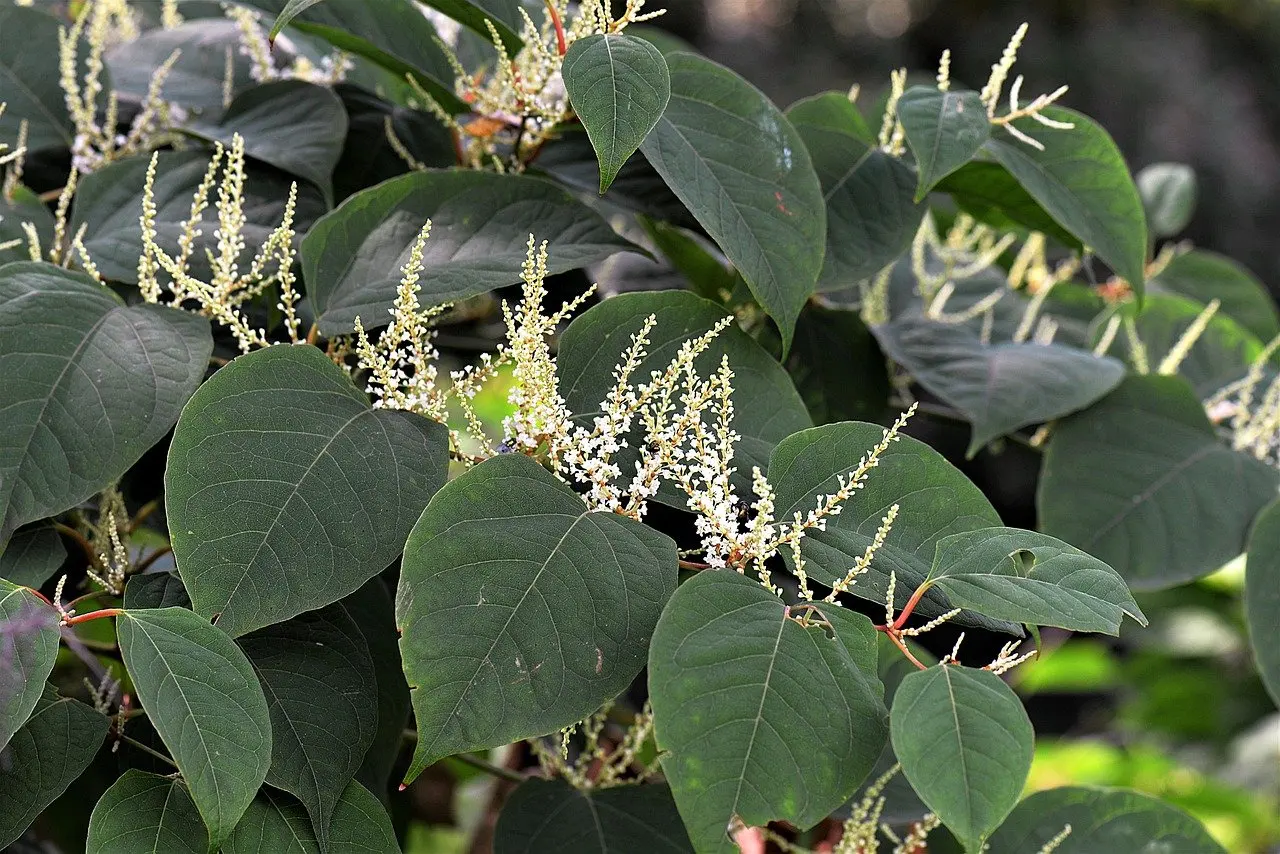
Japanese knotweed, scientific name Reynoutria japonica, is an invasive plant that you can recognize by its hollow, bamboo-like stalks, according to the Freeport Conservation Trust. The City of Bangor uses the same scientific name in its invasive plants guidance, which shows the plant’s leaves and flowers.
Stalks first
The stalk is the most reliable starting feature. Look for a hollow stem with the jointed, bamboo-like look that gives the plant its common comparison. Cut stems from a past season are worth checking too, because the hollow structure remains visible.
Leaves and flowers
Leaves and flowers are useful supporting evidence, not a substitute for the stalk check. Bangor’s identification photo pairs knotweed leaves with its flowers, so a plant showing both alongside hollow, bamboo-like stalks is a strong candidate. Photograph the whole plant, the stalk and a close view of a leaf before you report or treat it.
Why a small patch still matters
Knotweed has adapted to grow through gravel, tar and cement, so a patch at a driveway edge or along pavement is not contained by the hard surface. UMaine Extension adds that Maine’s short growing season and long winter do not do much to depress the species’ growth. Treat any confirmed patch as a priority rather than waiting to see whether it fades.
Look-alikes to rule out
Several plants get confused with invasives in Maine, and a few of them cause the same kind of mistaken identification. Work through the checks below before you cut or spray anything.
- Invasive honeysuckle: Its stems are hollow, while native honeysuckle stems have solid pith, according to the Freeport Conservation Trust. Because knotweed stalks are also hollow, a hollow stem alone does not separate the two. Confirm the bamboo-like stalk form and the overall plant before deciding.
- Buckthorn: It grows in densely and can be easy to mistake for a native sapling. If you are uncertain what a dense thicket is, identify it before removing it, so you do not clear native saplings.
- Purple loosestrife: It is often mistaken for fireweed, a native wildflower. This is a case of one invasive being taken for a native plant, so it is a reminder to identify by structure, not flower colour alone.
When a plant still does not fit, take photographs and ask a local conservation district or extension office before acting. Wrongly removing a native plant helps nobody, and a missed knotweed patch keeps spreading.
Where it grows and how to report it
Japanese knotweed is on the Cumberland County Soil and Water Conservation District’s list of common invasive plants in Maine, alongside Japanese barberry and Asiatic bittersweet. The Freeport Conservation Trust also names it among the worst invasive plants in Freeport. It sits within a larger picture: Maine has roughly 2,100 plant species, and about 2/3 of them are nonnative or invasive.
You can report invasive plants to the Maine Natural Areas Program through iMap Invasives, as the City of Bangor explains. Those reports help natural resource managers track where invasives are spreading in Maine, so a record of even a small patch has value. Report before treatment so the location is logged accurately.
Legal status and local rules
The supplied evidence shows local and agency measures rather than a single statewide planting rule. Bangor, for example, does not permit invasive plants to be planted in public spaces, and that is a city rule, not state law. If you manage land in another town, check with the municipal office before planting or moving any plant material.
For chemical control, the Maine Department of Agriculture, Conservation and Forestry publishes a list of companies licensed to control invasive terrestrial plants in Maine. That list is the right place to start if a stand is beyond what you can safely manage yourself.
Control through the growing season
UMaine Extension names frequent mowing or burning, along with the careful application of glyphosate, as the primary control methods. A herbicide is a product to apply with care, so follow the label and consider a licensed firm for anything large or near water.
- Confirm and photograph the stand. Use the stalk check and rule out look-alikes first.
- Report it. Log the location through iMap Invasives.
- Choose a method. Pick frequent mowing or burning, careful glyphosate use, or a combination, and burn only where it is safe and permitted.
- Repeat the work. A single cut does not finish the job on an established stand, so schedule return visits across the growing season.
- Bag or dry the debris. Handle it as described below before you leave the site.
Hand-pulling has a narrower place. The Freeport Conservation Trust advises pulling younger invasive plants when the soil is damp and the roots come up easily. That advice suits seedlings and small young plants, not a mature stand with a deep root network.
Handling cuttings and tools
Cuttings are where well-meant control often goes wrong. Invasive plants often spread by seed, root, stem, leaf and other plant fragments, so moving fresh material can start a new patch somewhere else. Treat every cutting as live.
- Do not compost. Invasive plant material put in compost will continue to grow.
- Dry it near the site. Hang the material on nearby branches until it dries out.
- Bag it for a permitted site. Once dry, bag it for removal at a permitted site, or burn it when safe and permitted.
- Check local drop-off rules. Freeport’s recycling center cannot take invasive plants, but the Riverside Recycling Facility in Portland accepts them for a fee, according to the Freeport Conservation Trust. Other towns will differ, so ask before you load a vehicle.
- Clean tools and boots. Do this after working, to avoid spreading seeds.
Following up in later seasons
Control does not end when the stems come down. The Cumberland County Soil and Water Conservation District advises monitoring managed areas for new growth or expansion, so the plant does not re-establish. Revisit the site through the growing season, repeat cutting where regrowth appears, and update your iMap Invasives record if the stand has changed. Regrowth through gravel, tar or cement at the edges of a managed area is a reason to keep checking, not a sign that the method failed.
Frequently asked questions
Does Maine’s cold climate keep knotweed in check?
No. UMaine Extension states that Maine’s short growing season and long winter do not do much to depress the species’ growth, so a cold winter is not a reason to delay action.
How long does it take to deal with a large stand?
UMaine Extension describes a large stand as a long-term project. Small patches are far easier to manage, which is why early identification and reporting matter.
Does the state recommend a particular control company?
No. The Maine Board of Pesticides Control publishes a list of licensed companies for invasive terrestrial plant control but does not recommend those firms above any others.