
Quick answer: For oriental bittersweet identification, look at where the fruit sits. Fruit tucked in the angle between leaf and stem marks the invasive vine; fruit at the ends of branches marks native American bittersweet.
Fruit position settles most doubtful cases, and fall and winter are the best seasons to check. This guide is part of our wider work on invasive species monitoring, where early recognition decides how much work removal takes later.
Choosing the trait to trust
Fruit position is the most dependable single check because it separates the two vines even when leaves and stems look alike. Use it first, and treat other traits as supporting evidence.
- Fruit is visible: check position. This is the fastest and clearest test, and it suits anyone with a vine in front of them between fall and winter.
- No fruit yet: note the leaves and vine size, mark the spot, and come back when fruit has formed rather than guessing.
- Fruit is on a vine you plan to cut or collect: confirm position before you handle it, because the two vines call for very different decisions.
Oriental and American bittersweet side by side
The table sets the two vines against the traits that matter in the field. The planning column turns each trait into a decision.
| Trait | Oriental bittersweet (Celastrus orbiculatus) | American bittersweet | Planning use |
|---|---|---|---|
| Fruit position | In the angle between the leaf shoot and the leaf, along the stem | At the ends of the branches | The deciding trait. Check it before any other. |
| Flower position | In the same leaf-angle positions as the fruit | At the ends of the branches | Lets you make the call in early summer, before fruit forms. |
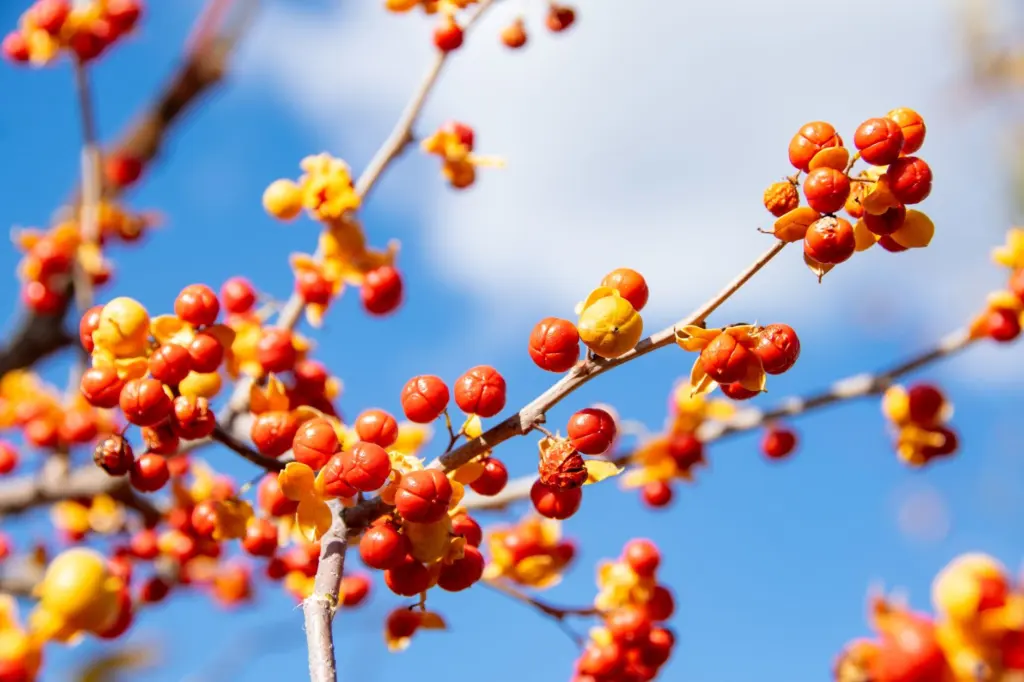
| Fruit appearance | Round yellow capsules that split to show bright red berries through fall and winter | Judge by position rather than colour alone | Yellow capsules in leaf angles are a strong warning sign. |
These contrasts come from the University of Maryland Extension’s oriental bittersweet woodland guide.
Fruit at the leaf axils
On oriental bittersweet, flowers and fruits sit in the angle between the leaf shoot and the leaf itself. That means clusters appear at intervals along the stem, close to where each leaf attaches, rather than collecting at the far end of a shoot.
Fruit at the branch tips
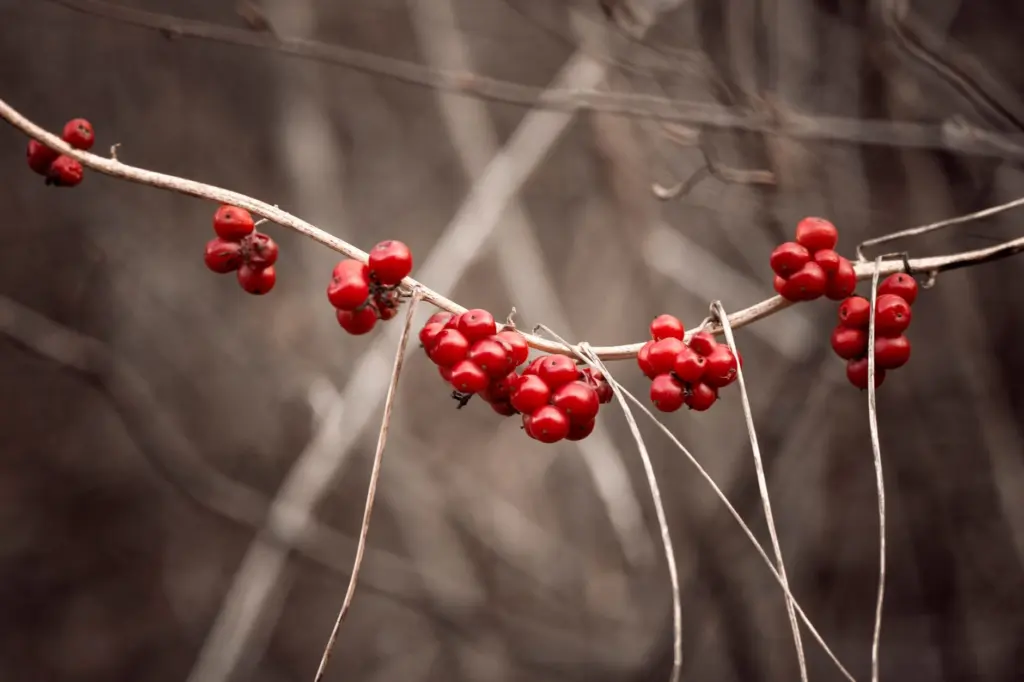
American bittersweet, the native species, carries its flowers and fruits at the ends of its branches. If every cluster you can find is terminal, you are most likely looking at the native vine. If you find clusters in leaf angles anywhere on the plant, treat it as oriental bittersweet.
Cornell Cooperative Extension also points readers to a video that shows how to tell invasive oriental bittersweet from native American bittersweet, which helps if you want to see the contrast in motion before heading out.
Leaves, vine size and growth habit
Oriental bittersweet has alternate, elliptical leaves that are light green, finely toothed and two to five inches long, according to University of Maryland Extension. Leaves alone are a weaker test than fruit position, so use them to flag a plant for a closer look rather than to settle the question.
Habit adds context. The vine can reach up to 60 feet in length and up to four inches in diameter, so a thick, long vine climbing a tree is a sign of an established plant. Cornell describes it as a vine that girdles and smothers plants and uproots trees because of its weight. A mature specimen in a woodland edge is therefore worth recording even before you confirm the species.
Seasonal checks
Oriental bittersweet is easiest to identify in fall and winter, when its round yellow fruits split open to show bright red berries. That window suits a first survey because the colour carries from a distance and the leaf-angle clusters are easy to see once leaves thin out.
- Early summer: look for flower position. Flowers in the leaf angles point to the invasive vine, and flowers at branch ends point to the native one.
- Fall: check fruit position and the yellow capsules splitting to red berries. This is the best time to confirm the species.
- Winter: berries persist through the winter months, so a second check is still useful if fall slipped by.
If you cannot see fruit, the practical choice is to mark the plant and return in fall instead of removing or collecting it on a guess.
Why the vine matters for trees and forests
Oriental bittersweet damages trees in two ways. According to University of Maryland Extension, the vine can girdle and kill a tree or break off its branches under its weight, and once it reaches the canopy it can shade out native species.
A USDA Forest Service study of southern Appalachian hardwood stands describes the vine as a serious threat to native forests in the eastern United States, which includes Maine woodlots. In that study, oriental bittersweet was present on 39% of the study area. Its occurrence increased where the overstory canopy was not dominated by oaks, and the study’s model classified 87% of sample plots correctly. The practical reading is that stands with a mixed or non-oak canopy deserve early attention, not that oak stands are safe.
The plant arrived in the United States around 1860, native to Korea, China and Japan, and was introduced as an ornamental and for erosion control, as Cornell Cooperative Extension of Schuyler County notes. It spreads in two ways: birds and other wildlife eat the many berries and carry the seeds far and wide, and the seeds can survive in the soil for up to two years without germinating.
Wreaths and decorations
Oriental bittersweet should not be used in wreaths or decorations. University of Maryland Extension notes that people spread the seeds by using the vines in decorations and craft projects, and the red berries that make the vine attractive are the same ones birds spread.
- Identify before harvesting: only fruit at branch ends points to the native vine. Fruit in leaf angles means leave it alone.
- Do not harvest on a doubt: an unconfirmed vine is better left in place than carried home with seeds attached.
- Keep fruiting material away from birds: any berried vine left outdoors can feed the spread described above, so bag unwanted material and put it in the trash.
What to do after a positive identification
Record the location and plan for follow-up, because oriental bittersweet is difficult to control once established. University of Maryland Extension advises that hand-pulling must remove the vine and all roots, to be bagged and put in the trash, and that re-sprouts should be watched for several years. Seeds that can persist in soil for up to two years are the reason a single pass is not enough.
Small infestations suit hand-pulling, while large vines already in the canopy call for more careful planning. Keep notes on each site so repeat visits are quick. The same habit applies to other shrubs and vines in your monitoring routine, as in our guide to japanese barberry identification. If you are comparing invasive plant strategies more broadly, purple loosestrife biological control galerucella shows a very different approach.
Troubleshooting uncertain identifications
- Fruit seems to be in both places: any cluster in a leaf angle points to oriental bittersweet, so do not treat the plant as native.
- No fruit at all: the plant may be young or it may be the wrong season. Record leaf traits and the vine’s size and return in fall.
- Leaves look right but fruit is missing: toothed, alternate, light green leaves fit oriental bittersweet, but wait for fruit position before drawing a conclusion.
- Heavy vines on a tree: prioritise the site, since girdling and canopy shading are the main damage routes.
Frequently asked questions
How do I tell oriental from American bittersweet?
Check where the fruit sits. Oriental bittersweet carries flowers and fruit in the angle between the leaf and the shoot, while American bittersweet carries them at the ends of its branches.
What damage does bittersweet do to trees?
Oriental bittersweet can girdle and kill a tree or break its branches under the vine’s weight, and a vine in the canopy can shade out native species.
When is bittersweet easiest to identify?
Fall and winter, when oriental bittersweet’s round yellow fruits split to reveal bright red berries and the fruit position is easy to see.
Can I use bittersweet in wreaths and decorations?
Not oriental bittersweet. Using its vines in decorations and crafts spreads its seeds. Confirm fruit position before harvesting any bittersweet, and leave anything uncertain where it is.