
| Field condition | What the evidence says | Planning use |
|---|---|---|
| Early leaf-out | Most invasive plants leaf out earlier than native trees and shrubs. | Scan woods, edges and hedgerows early in the leaf-out period, when invasives can stand out against later-leafing natives. |
| Mid-August | Foliar herbicide applications in mid-August are effective for most invasives. | Make treatment decisions, and any licence checks, before mid-August arrives. |
| Snow cover or wet bark | The basal bark method cannot be used with snow on the ground, and the base must be dry. It works on actively growing or dormant plants. | Do not plan basal bark work for snowy or wet days. Dormancy alone is not a barrier. |
| Disturbed soil or opened canopy | Soil disturbance and extra sunlight on the forest floor create conditions for non-native plants. | Revisit harvest areas, trail edges and clearings on a regular schedule. |
| Field identification | The Maine field guide covers 46 species of terrestrial and wetland invasive plants. | Confirm a plant against the guide before acting on a sighting. |
Timing and site conditions come from Maine Woodland Owners guidance on starting invasive control early. Species coverage comes from the University of Maine Extension announcement of the Maine invasive plants field guide.
This blog collects seasonal, field-ready notes on invasive species and Maine ecology, so readers can match what they see outdoors to the time of year and decide on a sensible next step.
The posts support the wider work on invasive species monitoring, where detection and response are covered as a whole. Here the focus is on shorter pieces tied to a season, a habitat or a single species.
Topics the blog covers
The blog covers invasive species, Maine ecology and seasonal phenology, and each post is built around something a reader could check outdoors. It is not a general news feed. A post should help someone decide what to look for, where and when.
- Species spotlights. Profiles of a single invasive plant, covering how to recognise it, where it grows in Maine and what the state’s guidance says about it.
- Seasonal timing. Notes on when plants leaf out, when treatment windows are described as effective and when weather rules out a method.
- Maine ecology context. Explanations of how woodlands, wetlands and shorelines respond to disturbance, and why native communities matter in the comparison.
- Field tools and write-ups. Practical posts on notebooks, guides, photographs and the way observations become clear records.
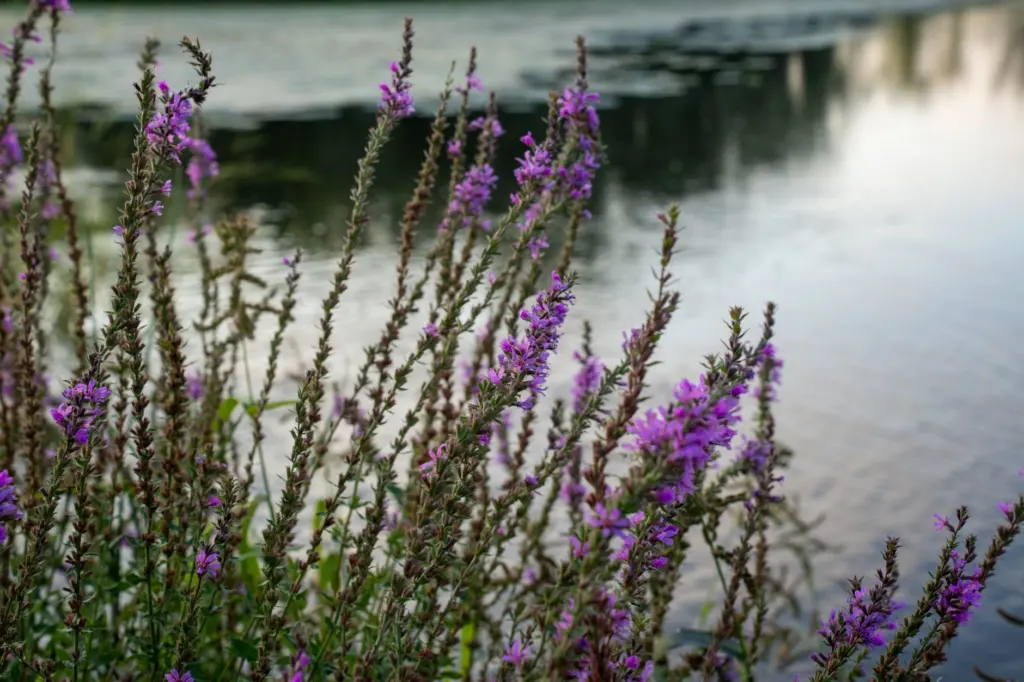
Topical posts often start at the water’s edge or the woodland margin, where a single plant in bloom is easy to notice and easy to misidentify. A shoreline post would explain what to compare, what to photograph and what to confirm with a guide before drawing a conclusion.
Using posts to plan field timing
The most useful consequence of reading seasonally is that a monitoring visit can be timed to the plants rather than to a free weekend. The choices below follow the conditions in the table at the top of this page.
Early in the season
Because most invasive plants leaf out earlier than native trees and shrubs, the early part of the growing season is a practical time to scan. Early leaves on a shrub in an otherwise bare understorey are worth noting and checking.
- Walk edges and openings. Field margins, old roadsides and the borders of woodlots are where early-leafing shrubs are easiest to see.
- Return after natives leaf out. A plant noted early can be confirmed later against the guide, once more of its features are visible.
- Record the date. A dated note makes year-to-year comparison possible, which is the point of seasonal posts.
Late summer and treatment windows
Maine Woodland Owners describes foliar herbicide applications in mid-August as effective for most invasives. That makes the weeks before it the time to confirm identification, map the patch and settle who will do the work. A post on treatment timing would cover those preparation steps rather than the application itself.
Dormant plants and winter work
The basal bark method is described as effective whether plants are actively growing or dormant. Two limits apply: it cannot be used when snow is on the ground, and the base of the plant must be dry. Winter planning therefore depends on the weather on the day more than on the calendar.
Disturbed ground
Anytime soil is disturbed or more sunlight reaches the forest floor, conditions favour non-native plants. A harvest area, a new trail or a storm gap is a better candidate for a repeat visit than undisturbed forest. If you can only monitor a few places, start with those.
Species spotlights and identification
Species posts rely on the Maine Invasive Plants Field Guide, which the Maine Natural Areas Program, part of the Maine Department of Agriculture, Conservation and Forestry, published in June 2019. It covers 46 species of terrestrial and wetland invasive plants. Each species account includes key identification characters, growth form, habitats invaded, control methods and status in Maine, which gives a post a clear structure to follow.
Maine Woodland Owners lists some common woodland invasives to look for: Asiatic bittersweet, Japanese barberry, buckthorn, honeysuckles, Norway maple, autumn olive and multiflora rose. Several of these are shrubs, so the early leaf-out habit described above applies to a good part of that list.
Why timing and disturbance shape the posts
Maine Woodland Owners describes the guiding idea for invasive control as early detection and rapid response. It calls this the mantra of invasive control experts. The sections above follow from it: a small patch found early is easier to deal with than an established one, so the posts focus on the moments when a plant is easiest to spot.
The leaf-out pattern is the clearest example of phenology at work. A plant that leafs out earlier than its native neighbours is visible earlier, and that visibility is an opening for a monitor. Disturbance works the other way. Opened soil and extra light create conditions for non-native plants, so the same sites keep returning as priorities for repeat checks.
The posts treat these as practical cues, not as predictions for any single site. A seasonal note says where to look first and what to confirm, and the ground itself decides the rest.
From field notes to write-ups
Some posts follow a field visit through to a finished record. The aim is a note that someone else could use: a place described clearly, a date, the plant’s growth form and habitat, and a photograph that shows the identifying features named in the guide.

- Write while the detail is fresh. Notes taken in the field hold up better than recollections later.
- Match the vocabulary of the guide. Using the same terms for growth form and habitat makes a record easier to compare with the species account.
- Keep observation and interpretation apart. What was seen belongs in one line, and what it might mean in another.
Frequently asked questions
What is an invasive species?
Maine Woodland Owners describes an invasive species as an exotic, non-native species that rapidly spreads into indigenous habitats.
Do I need a licence to treat invasive plants?
A licence is required to apply herbicide to any land other than your own. Maine Woodland Owners advises checking with the Maine Board of Pesticide Control, 287-2731, before treating land you do not own.
What does the Maine invasive plants field guide look like?
It is a waterproof, portable, ring-bound field guide measuring 3.75 x 8 inch. The ring binding allows future additions, which suits use outdoors.